FREE Delivery Across the UK & Ireland


Rodents are among the most troublesome household and commercial pests. Whether it’s a mouse sneaking into your kitchen or rats invading a warehouse, these unwanted visitors can damage property, contaminate food, and spread harmful bacteria. Choosing the right trapping solution is one of the most effective ways to tackle an infestation quickly.
Two of the most popular rodent control products are sticky traps and snap traps. Both have their own advantages, but the best choice depends on the severity of the infestation, the location of the rodents, and your personal preferences.
In this guide, we’ll compare sticky traps and snap traps in detail, helping you determine which solution works best for your pest control needs.
Understanding Sticky Traps
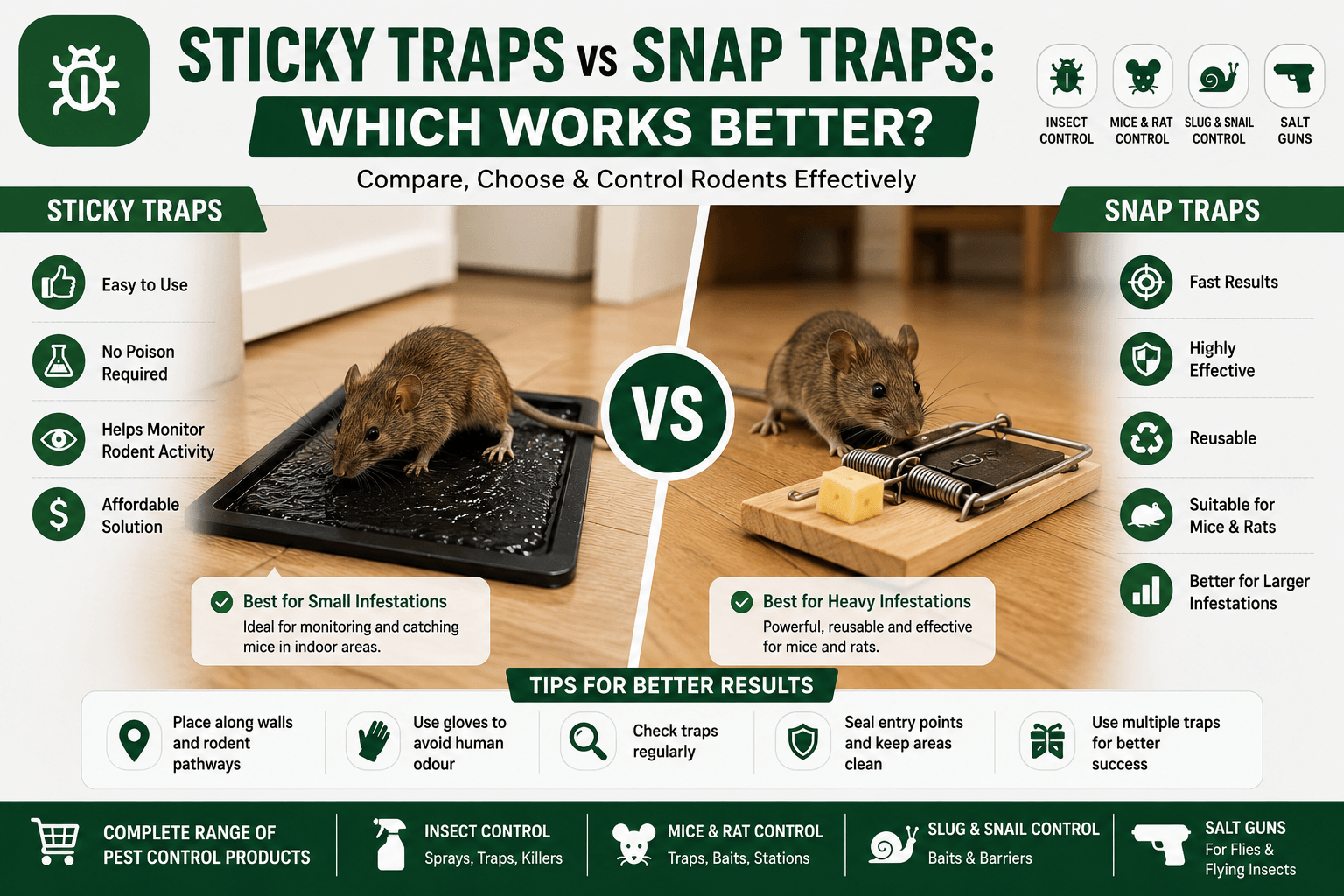
Sticky traps, also known as glue traps, are flat boards coated with a powerful adhesive. When a mouse or rat walks across the surface, it becomes stuck and cannot escape.
These traps are commonly used in homes, offices, shops, warehouses, garages, and storage rooms where rodent activity has been noticed.
Advantages of Sticky Traps
1. Easy to Use
Sticky traps require virtually no setup. Simply remove the protective cover and place the trap along walls or areas where rodents frequently travel.
2. No Poison Required
Unlike rodenticides, sticky traps do not rely on toxic chemicals, making them suitable for situations where poison isn’t preferred.
3. Helps Monitor Rodent Activity
Glue traps allow homeowners and pest control professionals to identify where rodents are active. They also catch insects such as cockroaches and spiders in some situations.
4. Affordable Solution
Sticky traps are generally inexpensive and ideal for monitoring small infestations before they become serious.
Limitations of Sticky Traps
While glue traps offer several benefits, they also have some drawbacks.
- Less effective against large rats
- Dust and dirt reduce adhesive strength
- Can become ineffective in damp environments
- Usually suitable for smaller infestations rather than heavy rodent problems
If your property has a significant rat infestation, stronger control methods may be necessary.
Understanding Snap Traps
Snap traps are one of the oldest and most reliable rodent control solutions available. They use a spring-loaded mechanism that instantly captures rodents when triggered.
Modern snap traps have improved significantly, offering safer designs, easier bait placement, and stronger triggering mechanisms.
They remain one of the most recommended products for controlling both mice and rats.
Advantages of Snap Traps
1. Fast Results
Snap traps are designed to eliminate rodents instantly when properly positioned.
2. Highly Effective
When baited correctly and placed along rodent pathways, snap traps have an excellent success rate.
3. Reusable
Many high-quality snap traps can be cleaned and reused multiple times, making them cost-effective.
4. Suitable for Larger Rodents
Unlike glue traps, snap traps can effectively capture larger rats as well as mice.
5. Better for Larger Infestations
If you’re dealing with multiple rodents, placing several snap traps throughout the affected area can provide faster results.
Limitations of Snap Traps
Snap traps are highly effective but require careful handling.
Some disadvantages include:
- Require bait
- Need correct placement
- Must be checked regularly
- Spring mechanism should be handled carefully
However, when used properly, they remain one of the most reliable rodent control methods available.
Sticky Traps vs Snap Traps: Side-by-Side Comparison
| Feature | Sticky Traps | Snap Traps |
|---|---|---|
| Ease of Use | Very Easy | Easy |
| Setup Time | Minimal | Requires Bait |
| Reusable | Usually No | Yes (Most Models) |
| Effective for Mice | Excellent | Excellent |
| Effective for Rats | Limited | Excellent |
| Cost | Low | Moderate |
| Indoor Use | Yes | Yes |
| Outdoor Use | Limited | Yes (Protected Areas) |
| Monitoring Activity | Excellent | Good |
| Long-Term Control | Moderate | Excellent |
Which Trap Works Better?
The answer depends on your situation.
Choose Sticky Traps If:
- You want to monitor rodent activity.
- You suspect only one or two mice.
- You need a quick, inexpensive solution.
- You’re placing traps in cupboards, storage rooms, or behind appliances.
Choose Snap Traps If:
- You have recurring rodent problems.
- You’re dealing with rats as well as mice.
- You want faster and more reliable control.
- You need reusable pest control equipment.
For most homeowners, snap traps provide the best long-term results.
Where Should You Place Rodent Traps?
Correct placement is just as important as choosing the right trap.
Rodents rarely travel through open spaces. Instead, they follow walls and hidden pathways.
Place traps:
- Along walls
- Behind refrigerators
- Under kitchen cabinets
- Near food storage areas
- Inside garages
- In lofts and attics
- Around warehouses
- Near utility rooms
Avoid placing traps in the center of rooms where rodents rarely travel.
Tips for Better Results
To maximize trapping success:
Use Multiple Traps
One trap is rarely enough. Place several traps throughout areas with rodent activity.
Avoid Strong Human Odours
Wear disposable gloves when handling traps to reduce scent transfer.
Inspect Regularly
Check traps daily and replace or reset them as needed.
Remove Food Sources
Store food in sealed containers and clean up crumbs immediately.
Seal Entry Points
Even the best traps won’t solve the problem if rodents continue entering your property. Seal gaps around pipes, doors, vents, and foundations.
Complete Rodent Control Requires More Than Traps
While sticky traps and snap traps are highly effective, combining them with other pest control products creates the best defence against rodents.
A complete rodent management plan may include:
- Professional snap traps
- Sticky glue boards
- Rodent bait stations (where appropriate)
- Monitoring traps
- Entry-point sealing
- Regular inspections
Using multiple methods helps reduce infestations more quickly and prevents rodents from returning.
Other Pest Control Solutions for Your Home and Business
Rodent control is only one part of maintaining a pest-free environment. A comprehensive pest control approach often includes solutions for various common pests.
Professional pest control stores typically offer products for:
Insect Control
Protect your property with insect sprays, insect traps, electric insect killers, fly killers, bug zappers, mosquito control products, and other insect management solutions.
Mice & Rat Control
Choose from snap traps, glue traps, bait stations, humane traps, and additional rodent control accessories for effective pest management.
Slug & Snail Control
Keep gardens and outdoor spaces protected with slug and snail control products designed to reduce plant damage.
Salt Guns
Salt guns provide a fun and practical way to target individual flies and other small flying insects indoors without using chemical sprays.
By selecting the right products for each pest, you can maintain a cleaner, safer, and more comfortable home or workplace.
Final Verdict
Both sticky traps and snap traps have their place in an effective rodent control strategy.
Sticky traps are ideal for monitoring activity and handling small mouse problems in low-risk environments. They are easy to use, affordable, and convenient for detecting pest movement.
Snap traps, however, remain the better choice for most homeowners and businesses. They offer faster results, greater effectiveness against both mice and rats, and can often be reused, making them a practical long-term investment.
For the best protection, combine high-quality rodent traps with preventative measures such as sealing entry points, maintaining cleanliness, and using additional pest control products for insects, slugs, snails, and flying pests. With the right approach, you can keep your property protected year-round and enjoy a healthier, pest-free environment.