FREE Delivery Across the UK & Ireland



Finding signs of rats around your home, business, garden, garage or outbuilding can be concerning. Rats can cause damage by gnawing materials, contaminate areas and create ongoing hygiene problems. Choosing the right rat trap is therefore an important part of an effective rodent-control strategy.
If you are looking for rat traps for sale in Newry, there are several options to consider. Different traps are designed for different situations, and choosing the cheapest or largest trap is not necessarily the best approach.
The right choice depends on factors such as where the trap will be used, the level of rat activity, the surrounding environment, access by children or pets and the type of trap itself.
This guide explains the main types of rat traps and what to consider before buying.
What Should You Look for in a Rat Trap?
A suitable rat trap should be appropriate for the target pest, practical for the intended location and capable of being used safely.
Before buying a trap, consider:
- Whether it is designed specifically for rats
- Where it will be placed
- Whether children or pets could access the area
- Whether the trap is suitable for indoor or outdoor use
- How easy it is to set and inspect
- Whether replacement parts are available
- Whether the trap complies with applicable requirements
Approved-trap requirements are particularly important. Guidance for Northern Ireland notes that spring traps used for rats should be approved under the relevant Northern Ireland approval arrangements.
Types of Rat Traps Available
There is no single rat trap that is ideal for every situation. The main categories include break-back or snap traps, enclosed traps and live-catch traps.
1. Snap or Break-Back Rat Traps
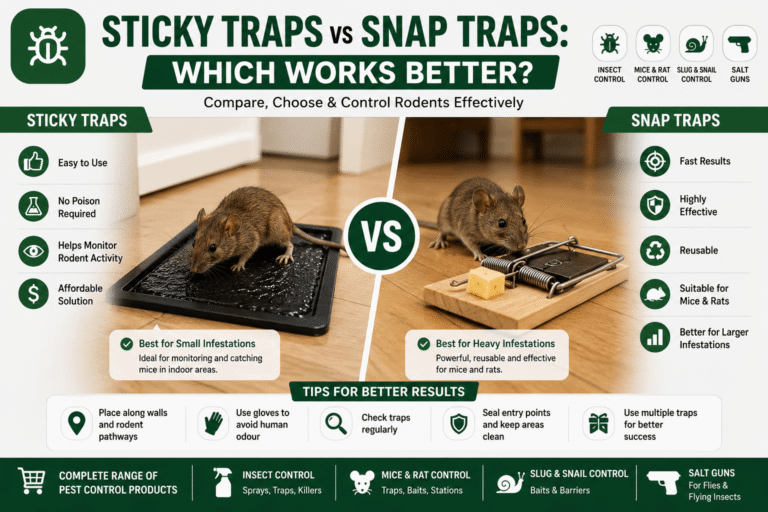
Snap traps use a spring-loaded mechanism that activates when a rat interacts with the trigger.
They are popular because they are relatively straightforward and can be effective when correctly selected and positioned.
Modern commercial rat traps can come in plastic, metal or combined constructions. Some designs are made specifically to fit inside protective trapping stations.
When choosing a snap trap, look for one designed for rats rather than mice. Rats are larger and stronger than mice, so a trap intended for a smaller rodent may not be suitable.
2. Enclosed Rat Traps
Enclosed traps or trapping stations can provide an additional level of protection around the trap mechanism.
This can be particularly useful in locations where there is a risk that pets, children or non-target animals could come into contact with the trap.
Purpose-made trapping boxes can help restrict access while allowing the target rodent to reach the trap. Rodent-control guidance recommends taking steps to minimise the risk to non-target animals and keeping traps away from areas where the public or animals can access them.
For domestic and commercial premises, an enclosed setup may therefore be worth considering where the environment requires additional protection.
3. Live-Catch Rat Traps
Live-catch traps are designed to capture a rat without killing it.
These traps may be considered by people who prefer a non-lethal trapping method. However, they require responsible management and regular checking.
A captured animal should not simply be left inside a trap. Before using a live-catch trap, make sure you understand the relevant animal-welfare requirements and what should be done after an animal is captured.
Live-catch traps may be more suitable for certain circumstances than others, so consider the nature of your rat problem before choosing this option.
Which Rat Trap Is Best?
The best rat trap depends on your circumstances.
For many situations, a properly selected and approved snap or break-back trap can provide a practical solution. An enclosed trap or trapping station may be preferable where there are concerns about access by pets, children or non-target animals.
A live-catch trap may be considered where non-lethal capture is specifically preferred and appropriate.
Here is a simple comparison:
| Rat Trap Type | Main Benefit | Important Consideration |
| Snap/break-back trap | Practical and straightforward | Must be safely positioned |
| Enclosed trap | Helps restrict access | Check compatibility and placement |
| Live-catch trap | Non-lethal capture | Requires regular checking |
| Multi-catch trap | Can capture more than one rat | Requires appropriate monitoring |
The right choice should be based on the environment rather than simply the price.
Where Should You Put a Rat Trap?
Correct placement is one of the most important factors in successful trapping.
Rats often travel along walls, edges and sheltered routes rather than moving across exposed open areas. Signs such as droppings, gnaw marks, grease marks or disturbed materials can help identify areas of activity.
Potential areas to investigate include:
- Along walls
- Behind suitable structures
- Near suspected entry points
- Around outbuildings
- Near areas where food is stored
- Around waste-storage areas
- Along established rodent travel routes
However, traps should never simply be left in an open or easily accessible location.
For external use, best-practice guidance recommends risk assessment and positioning traps where they cannot be accidentally triggered and where the general public cannot access them.
Should You Use Rat Traps Indoors or Outdoors?
The answer depends on where the rat activity is occurring.
Indoor rat control
Indoor traps may be appropriate in areas such as:
- Garages
- Utility rooms
- Storage areas
- Agricultural buildings
- Commercial premises
- Other locations where rat activity has been identified
The surrounding environment should always be considered before installation.
Outdoor rat control
Outdoor trapping requires additional care because there may be greater opportunities for non-target animals to encounter a trap.
If a trap is being used outdoors, consider access by:
- Pets
- Wildlife
- Livestock
- Birds
- Children
- Members of the public
A protective trapping station can be useful where appropriate. The specific trap and enclosure should be compatible and used according to the manufacturer’s instructions.
What Bait Should You Use?
Bait can help attract rats to some trap designs, but there is no universal bait that will work equally well in every location.
A suitable attractant may include strongly scented food such as peanut butter or another site-appropriate attractant. Guidance for rodent trapping also identifies attractants such as chocolate and peanut butter as examples for baited traps.
The key is to use only an appropriate amount and follow the instructions supplied with the trap.
It is also important to remember that food competition can affect trapping. If rats have easy access to large quantities of food elsewhere, they may be less interested in a trap.
How Many Rat Traps Should You Use?
The number of traps required depends on the size of the area and the level of rat activity.
If signs of activity are limited to one location, a targeted approach may be appropriate. If there are multiple areas showing evidence of rats, more than one trap may be necessary.
Avoid placing traps randomly throughout a property. Instead, identify areas where rat activity is occurring and consider how rats are likely to move through the environment.
If activity continues despite trapping, there may be an untreated entry point, food source or nesting area that needs attention.
Safety Matters When Using Rat Traps
Rat traps should always be treated as potentially dangerous equipment.
Keep traps away from children and pets, and use suitable protective equipment when handling traps or rodent carcasses.
Rodent-control guidance recommends that traps should not be set in open or accessible areas where members of the public, animals or pets can easily reach them. It also recommends appropriate protective clothing and equipment when handling traps and carcasses.
Always read the manufacturer’s instructions before setting a trap.
For outdoor use in particular, selecting an appropriate approved trap and considering non-target species is essential.
Rat Traps for Sale in Newry: What Should You Consider?
If you are comparing rat traps for sale in Newry, start by considering your specific application rather than searching only by price.
Ask yourself:
Where is the rat activity occurring?
Is it inside a house, garage, commercial building, farm building or outdoor area?
Are children or pets present?
If they are, an enclosed trapping arrangement may provide additional protection.
How serious is the activity?
A small, isolated issue may require a different approach from persistent activity across several areas.
Is the trap approved and appropriate for its intended use?
This is particularly important when selecting spring traps.
How easy is it to inspect and maintain?
A trap that is difficult to access may not be practical for regular monitoring.
For customers looking for pest-control equipment, Pest Control Shop NI can be considered when comparing rat traps and other equipment for rodent-control applications.
Preventing Rats From Returning
Trapping should not be viewed as the only part of rat control.
Once rat activity has been identified, look at why rats are accessing the property in the first place.
Useful preventative measures include:
Seal potential entry points
Inspect gaps around doors, pipes, walls, drains and other possible access points.
Secure food
Store food and animal feed in suitable sealed containers and avoid leaving food readily accessible.
Manage waste
Use suitable closed waste containers and maintain clean waste-storage areas.
Reduce hiding places
Remove unnecessary clutter, waste materials and other potential shelter around buildings.
Check external areas
Look for conditions that could provide rats with food, water or shelter.
These measures can make an area less attractive to rodents and reduce the chance of repeated activity.
When Should You Consider Professional Pest Control?
Trapping may be suitable for some situations, but persistent rat activity can require a more comprehensive approach.
Consider professional pest-control advice if:
- You repeatedly see rats
- Fresh droppings continue to appear
- There are extensive signs of gnawing
- Rats are entering occupied buildings
- You cannot identify the entry point
- Trapping does not appear to reduce activity
- The problem affects a food-related business
- There is a significant risk to children, pets, livestock or the public
A professional can assess the site, identify likely access routes and determine an appropriate control strategy.
Final Thoughts
Choosing the right rat trap is about more than finding the cheapest product. The trap should be suitable for rats, appropriate for the location and used in a way that minimises risks to people, pets and non-target animals.
If you are looking for rat traps for sale in Newry, consider the type of trap, intended location, level of activity, safety requirements and ongoing monitoring before making your choice.
For a broader rodent-control approach, Pest Control Shop NI offers pest-control equipment that can help customers select products suited to different pest-management applications. Remember that trapping works best as part of a wider strategy that includes removing food sources, securing waste, reducing shelter and preventing rats from accessing the property in the first place.
Frequently Asked Questions
What is the best rat trap for use around a property?
For many situations, an appropriate approved snap or break-back trap can be effective when correctly positioned. Enclosed trapping arrangements can be preferable where non-target access is a concern.
Can I use a mouse trap to catch rats?
It is generally better to use a trap specifically designed for rats. Rats are larger and stronger than mice, so a mouse trap may not be appropriate.
Where should rat traps be placed?
They should be positioned in areas where rat activity has been identified, such as along suitable travel routes and near signs of activity. Traps must also be positioned safely and away from unauthorised access.
How often should rat traps be checked?
Checking requirements depend on the type of trap, circumstances and applicable guidance. Best-practice rodent-control guidance recommends regular inspection and, for certain trapping situations, daily checks.
Are enclosed rat traps better?
Enclosed traps or trapping stations can help restrict access to the trap and may be particularly useful where children, pets or non-target animals could otherwise reach it.