FREE Delivery Across the UK & Ireland


Flies can become a serious problem for businesses, particularly in environments where food is prepared, stored or served. Restaurants, cafés, food-processing premises, warehouses, shops and other commercial properties need an effective way to manage flying insects while maintaining a clean and professional environment.
A commercial fly zapper can be an important part of an integrated pest-control strategy. But with different sizes, designs, coverage areas and installation options available, how do you choose the right one for your business?
The answer depends on several factors, including the size of your premises, the level of fly activity, the location of the unit and the type of business you operate.
This guide explains the key factors to consider before purchasing a commercial fly zapper.
What Is a Commercial Fly Zapper?
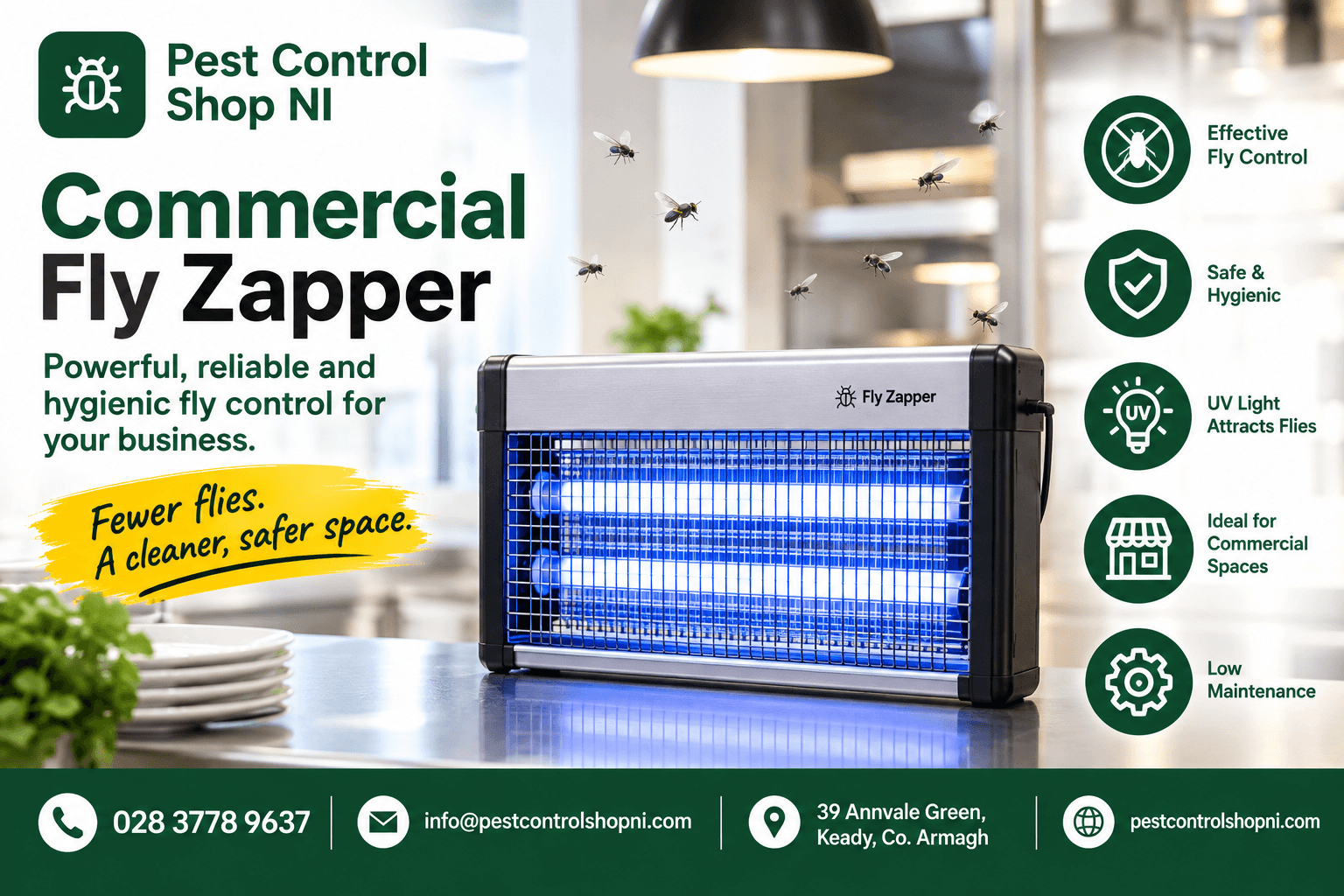
A commercial fly zapper is an electrical insect-control device designed to attract flying insects using ultraviolet light. When an insect approaches the electrical grid, it is eliminated by an electrical discharge.
Commercial units are generally designed for environments where there may be higher levels of flying-insect activity than in a typical domestic setting.
They are commonly considered for:
- Restaurants and cafés
- Food shops and bakeries
- Commercial kitchens
- Hotels and hospitality businesses
- Warehouses
- Food-storage areas
- Retail premises
- Agricultural and industrial environments
A fly zapper should not be considered a replacement for good hygiene and preventative pest management. Instead, it can form part of a broader approach to controlling flying insects.
Why Do Businesses Need Commercial Fly Control?
A few flies can quickly become a bigger concern in a busy commercial environment. Aside from being unpleasant for customers and employees, flies can move between contaminated and clean areas.
This makes flying-insect control particularly important for businesses handling food.
An appropriate commercial fly zapper can help by continuously attracting flying insects and reducing their presence in suitable areas. It can also provide a practical monitoring and control solution when combined with good sanitation practices.
However, businesses should always consider their industry’s hygiene requirements and any applicable regulations when selecting and installing pest-control equipment.
1. Consider the Size of Your Premises
One of the first things to consider is the area that needs protection.
A small café does not necessarily require the same type or capacity of fly zapper as a large warehouse or food-production facility.
Before buying, check the manufacturer’s stated coverage area and compare it with the size and layout of your premises.
For larger businesses, you may need more than one unit rather than relying on a single powerful device.
Think about:
- Total floor area
- Ceiling height
- Number of rooms
- Internal walls and partitions
- Areas with frequent door opening
- Locations where flies are most active
The goal is to position suitable units where flying insects are most likely to encounter them.
2. Look at the Type of UV Light
The UV light is a key component of an electric fly zapper because it attracts many flying insects towards the device.
When comparing models, consider the quality and configuration of the UV light source, as well as replacement requirements.
Some commercial units are designed for continuous operation, while others may be better suited to particular environments.
Check the manufacturer’s specifications for:
- UV lamp type
- Number of lamps
- Lamp wattage
- Recommended replacement interval
- Coverage area
Replacement lamps and other consumable parts should also be considered when calculating the long-term cost of the equipment.
3. Choose the Right Installation Location
Even a good commercial fly zapper may perform poorly if it is installed in the wrong position.
Flies are attracted to light, so positioning the unit strategically can help maximise its usefulness.
Suitable locations may include areas where flying insects commonly enter or gather, provided the installation does not create a safety or hygiene issue.
For example, a business might consider positioning a unit:
- Near entrances
- Around waste-management areas
- In suitable food-service areas
- Near suspected fly entry points
- In storage areas
- Along common insect flight paths
Avoid placing a fly zapper where it could interfere with customers, employees or food-handling procedures.
Always follow the manufacturer’s installation instructions.
4. Think About Hygiene and Cleaning
Commercial pest-control equipment needs regular maintenance.
Fly zappers collect insect remains, dust and other debris during normal operation. A dirty unit may become less effective and can create unnecessary hygiene concerns.
When selecting a commercial fly zapper, consider how easy it is to:
- Remove accumulated debris
- Access the collection area
- Clean the unit
- Replace lamps
- Inspect the electrical components
- Carry out routine maintenance
For a busy commercial environment, a design that is straightforward to maintain can save time over the life of the product.
5. Consider Your Business Environment
Not every commercial property has the same pest-control requirements.
For example, a restaurant may need to consider food hygiene and customer visibility, while a warehouse may be more concerned with coverage and placement.
A food-related business should pay particular attention to where the fly zapper is positioned in relation to food preparation, storage and service areas.
Businesses in Newry, Keady, Monaghan and Dundalk, for example, may operate in very different premises, so the ideal commercial fly zapper should be selected based on the individual environment rather than simply choosing the largest available unit.
The same principle applies to businesses in Banbridge, Dungannon, Cookstown and Craigavon. Premises size, layout, activity and insect pressure can vary considerably between businesses.
6. Compare Commercial and Domestic Fly Zappers
A common mistake is assuming that any electric fly zapper can be used in a commercial environment.
Domestic units may be suitable for homes or smaller spaces, but commercial premises often require equipment designed for more demanding conditions.
Commercial fly zappers may offer:
- Larger coverage
- More robust construction
- Higher-capacity operation
- Easier maintenance
- Commercially appropriate installation options
Before buying, check whether the product is specifically intended for commercial use and whether its specifications match your business requirements.
7. Consider Ongoing Costs
The purchase price is not the only cost to consider.
A commercial fly zapper may require replacement UV lamps, cleaning and occasional maintenance. Some units may also consume more electricity than smaller domestic models.
When comparing products, consider the total cost of ownership rather than focusing only on the initial price.
Ask:
How often do the lamps need replacing?
How easy are replacement parts to obtain?
How much maintenance does the unit require?
Is the coverage appropriate for the price?
These questions can help you choose equipment that provides better long-term value.
8. Don’t Ignore Prevention
A commercial fly zapper can help control flying insects, but it should not be the only pest-management measure used by a business.
Good prevention can significantly reduce the conditions that attract flies.
Businesses should consider:
- Keeping food covered where appropriate
- Cleaning spills promptly
- Maintaining waste bins
- Removing rubbish regularly
- Keeping doors closed when practical
- Checking windows and screens
- Cleaning food-preparation areas thoroughly
- Addressing potential sources of flies
If flies continue appearing despite good hygiene and suitable equipment, investigate where they may be entering or breeding.
Choosing a Commercial Fly Zapper in Northern Ireland and Nearby Areas
Businesses across towns such as Portadown and Lurgan, as well as Newry, Banbridge, Craigavon and surrounding areas, may have different commercial environments requiring different pest-control equipment.
Rather than choosing a fly zapper based purely on price or appearance, consider the actual requirements of your premises.
For example, a small retail unit may need a different solution from a large food warehouse. Similarly, a busy restaurant may have different placement considerations from a storage facility.
For businesses looking for commercial pest-control equipment, Pest Control Shop NI can be a useful starting point when comparing equipment for different applications.
Final Thoughts
Choosing the right commercial fly zapper is about more than selecting the most powerful or expensive model. The best choice depends on your premises, coverage requirements, insect activity, installation location, maintenance needs and business environment.
Before purchasing, check the manufacturer’s specifications, consider ongoing maintenance costs and think carefully about where the equipment will be installed. Whether your business operates in Newry, Keady, Monaghan, Dundalk, Banbridge, Dungannon, Cookstown, Craigavon, Portadown or Lurgan, selecting pest-control equipment based on your actual premises and requirements can help you build a more practical flying-insect management strategy.
Frequently Asked Questions
What size commercial fly zapper do I need?
The appropriate size depends on the manufacturer’s stated coverage area and the layout of your premises. Larger premises may require multiple units.
Where should a commercial fly zapper be installed?
Position it where flying insects are likely to travel or enter, while ensuring it does not create a hygiene, safety or operational issue. Always follow the manufacturer’s instructions.
Are commercial fly zappers suitable for restaurants?
They can be suitable for restaurants, but positioning is particularly important around food-handling areas. Businesses should follow relevant food-hygiene requirements and equipment guidance.
How often should a commercial fly zapper be cleaned?
Cleaning frequency depends on insect activity and the manufacturer’s instructions. Busy environments may require more frequent inspection and cleaning.
Is a commercial fly zapper enough to control flies?
No. A fly zapper should generally be considered one component of an integrated pest-control approach. Hygiene, waste management, exclusion and identifying sources of fly activity remain important.